
List of Data Engineering Services US Businesses Need in 2026
Organizations in the US are generating more data than ever through apps, user interactions, connected devices, transactions & digital platforms. The growth in AI adoption and cloud migration is increasing the requirement for reliable data infrastructure that can manage large & complex workloads. To gain value from this information, firms need data that is structured, accessible, and accurate when required. Scalable data environments also offer the foundation for analytics and AI initiatives.
Professional data engineering services help firms build and maintain this foundation by developing data pipelines, advanced platforms and integration systems, while improving data quality and governance. According to dbt Labs, over 56% of data teams report poor data quality as a major challenge, highlighting the need for a strong data engineering foundation. Organizations can select services based on data maturity and strategic goals. In 2026, firms may also partner with specialized Chicago data engineering services to modernize their data infrastructure.
This guide helps explore the key data engineering services in Chicago that US businesses should consider to develop scalable, reliable, and future-ready data environments.
What Are Data Engineering Services?
Businesses can gather, transform, integrate, store, and manage data from various sources with the help of a data engineering company. The pipelines and systems that make data dependable and available for analytics and applications are constructed by data engineers. Data engineering establishes the framework, in contrast to data science, which builds predictive models, and data analytics, which concentrates on data interpretation. Additionally, it gets data ready for workloads involving AI and machine learning.

Why US Businesses Need Data Engineering Services in 2026
➥ Growing enterprise data volumes
Scalable systems that can effectively store, process, and manage information are becoming more and more necessary as businesses generate more data from applications, customers, devices, and transactions.
➥ Increased adoption of AI and generative AI
Reliable, accessible, and well-structured data is necessary for the growing adoption of AI and generative AI. Organizations can create reliable AI applications by preparing high-quality datasets and pipelines with the help of data engineering services in Chicago.
➥ Need for real-time business intelligence
In order to react swiftly to customers, market shifts, operational problems, and new opportunities, businesses require more and more up-to-date information. Faster access to useful business insights is made possible by real-time data engineering.
➥ Increasing cloud and multi-cloud adoption
Data architectures that integrate platforms, effectively manage workloads, and maintain consistent data access across increasingly distributed technology environments are essential as organizations embrace cloud and multi-cloud environments.
➥ Demand for better data quality and governance
Analytics and decision-making can be hampered by low-quality data. Organizations can increase data accuracy, control access, establish ownership, and maintain consistent information by combining strong engineering practices with governance.
➥ Need to connect fragmented business systems
Disconnected CRM, ERP, SaaS, databases, and legacy systems are used by many companies. These environments are connected by data engineering, which also reduces data silos and improves information flows throughout operations.
Also Read : Data Engineering Trends in 2026 Driving AI and Real-Time Analytics
List of Data Engineering Services Businesses Need
1. Data Engineering Consulting Services
Businesses can identify areas where their current data environment is lacking and what needs to be changed with the help of data engineering consulting services. Consultants evaluate data flow, evaluate current infrastructure, and identify problems that impact analytics, reporting, and application performance. They develop a practical plan to improve the data environment without unnecessary complexity based on these findings.
The business needs, current systems, scalability requirements, and financial limitations can then be taken into consideration when choosing the appropriate architecture, platforms, and technologies. This strategy provides organizations with a clear path for updating their data capabilities and getting ready for future expansion. Additionally, it helps companies become aware of expensive technology choices and improve their foundation for AI, automation, and analytics projects.
2. Data Architecture Design
Businesses can gather, store, process, and use information in an organized manner with the help of a well-thought-out data architecture. The creation of environments that can manage present workloads while remaining adaptable as data volumes rise is the main goal of data architecture design services. Based on business needs, experts specify storage, processing, integration, and access requirements.
Depending on the technology landscape of an organization, the architecture can be created for cloud, hybrid, or multi-cloud environments. Additionally, adding new data sources, applications, and analytical workloads over time is made simpler by a scalable design. Organizations can lower complexity, improve performance, and develop an environment that supports reporting, analytics, machine learning, and future digital initiatives.
3. Data Pipeline Development
Businesses can effortlessly transfer data between various platforms and systems thanks to data pipeline development. Organizations can set up pipelines that gather, process, transform, and deliver data in accordance with predetermined workflows rather than depending on manual data transfers. Databases, apps, cloud platforms, APIs, and other business systems can all be connected by these pipelines.
The timely and consistent delivery of data to analytics platforms is facilitated by automated ingestion and transformation. Businesses can make data more accessible for reporting, business intelligence, operational analysis, and other applications with data engineering consulting services. Businesses rely on accurate and current information by streamlining the flow of information throughout the company.
4. ETL and ELT Development
Organizations can transfer data from various sources into platforms for analysis and efficient use with the help of ETL and ELT development. Information is extracted and transformed in compliance with business rules and processes. ELT methods load the data before transforming it on the destination platform. Businesses can implement either strategy or a mix of the two, depending on the workload and technology environment.
These services assist in automating repetitive processing tasks, standardizing data, and eliminating inconsistencies. Managing increasing data volumes and shifting source systems is also made simpler by well-designed workflows. A more trustworthy database for reporting, analytics, dashboards, and operational decision-making is the end result.
5. Data Integration Services
Data stored across databases, SaaS apps, ERP systems, CRM platforms, APIs, and other business tools is connected by data engineering services. Important information may remain isolated in separate systems in the absence of adequate integration, resulting in data silos and making it challenging to obtain a comprehensive understanding of business operations. Integration solutions eliminate repetitive manual procedures while establishing consistent data flows between these environments.
Additionally, they can ensure that teams have access to the data they require and help synchronize information across applications. Depending on their current technological environment, businesses can integrate both on-premises and cloud-based systems. It offers better reporting, more efficient workflows, improved departmental collaboration, and more uniform access to business information.
6. Cloud Data Engineering
Using cloud infrastructure and services, cloud data engineering assists companies in creating and updating data environments. Businesses can introduce cloud-native technologies where they clearly offer business value, redesign current data processes, and transfer legacy workloads to scalable cloud platforms. Cloud-based environments can accommodate varying data volumes without requiring ongoing physical infrastructure expansion for businesses.
To improve performance and better control cloud spending, engineering teams can also examine workload, processing, and storage trends. An organization’s architecture should be in line with its security, integration, performance, and scalability requirements, whether it is launching a new cloud data platform or updating an old one.
7. Data Warehouse Development
The development of a data warehouse establishes a central location for the organization of structured business data for reporting and analysis. Teams can obtain a more reliable source of BI by gathering, transforming, and storing data from several operational systems in a uniform format. A well-designed warehouse may improve query performance, streamline reporting, and lessen the amount of work needed to manually compile data.
Companies can design warehouses according to their own data models, business procedures, and reporting needs. Decision-makers can obtain information more easily by integrating modern data warehouses with analytical platforms and visualization tools. Organizations can increase performance visibility, detect trends, and use consistent business data to make decisions by establishing a solid reporting foundation.

8. Data Lake and Lakehouse Development
Businesses can manage massive amounts of structured, semi-structured, and unstructured data with the help of data lake and lakehouse development services. While a lakehouse combines features typically found in data lakes and data warehouses, a data lake offers a flexible environment for storing raw data from various sources. Within a more cohesive data environment, this strategy can support workloads related to analytics, machine learning, and artificial intelligence.
While maintaining flexibility for potential future use cases, businesses can gather data from applications, devices, databases, documents, and other sources. Depending on the demands of the workload, teams can create suitable models for processing, storage, governance, and access. Organizations can strengthen the foundation for advanced analytics and AI initiatives and manage massive datasets more easily with the correct architecture.
9. Data Migration and Modernization
Businesses can transfer data and workloads from outdated platforms to more modern, scalable environments with the help of data migration and modernization services. This may include moving data into modern warehouses, lakes, or lakehouses, replacing outdated databases, or moving on-premise systems to the cloud. To preserve access to vital information, minimize disruption, and safeguard data integrity, the procedure needs to be carefully planned.
Engineering teams are able to evaluate current workloads, find dependencies, clean data as needed, and create a methodical migration strategy. Additionally, modernization can lessen dependency on outdated infrastructure and facilitate data access across teams and applications. Improved analytics, automation, scalability, and future technology adoption are all made possible by a well-managed migration.
10. Real-Time Data Processing
Instead of waiting for planned batch processes, businesses can work with information as it is generated thanks to real-time data processing. Applications where timely information can affect operational choices, customer experiences, alerts, or business responses can benefit from this. Continuous processing and delivery of streaming data to the systems that require it is possible from applications, devices, transactions, and other sources.
Real-time processing allows businesses to support time-sensitive analytics, transaction monitoring, automated alerts, and live dashboards. Pipelines that reliably handle incoming data can be designed by the team while taking system availability, scalability, and processing speed into consideration. Organizations can react more quickly to changing circumstances and make decisions based on up-to-date data when they have timely access to operational information.
11. Data Quality Management
Businesses can ensure the accuracy, consistency, and usability of the data used for operations, analytics, and reporting by implementing data quality management. Duplicate records, missing fields, inconsistent formats, out-of-date information, or mistakes made during data movement can all lead to low-quality data. To find these problems before they impact downstream systems, data engineering teams can set up validation rules and automated checks.
Consistent definitions and formats across various business sources can also be produced with the help of standardization procedures. Frequent monitoring makes it simpler to identify recurring quality issues and deal with them where they originate. Organizations can strengthen trust in reports and analytics, decrease manual correction work, and give teams information they can use to make daily decisions by improving data quality.
12. Data Governance and Security
Organizations can set clear guidelines for the management, access, protection, and use of business information with the help of data governance and security services. Data ownership, responsibilities, policies, classification standards, and access requirements across various systems can all be specified by governance frameworks.
These procedures support internal and regulatory compliance requirements while assisting organizations in keeping more control over their data. From consuming data and storage to processing and consumption, security measures can be integrated at every stage of the data lifecycle. In addition to providing businesses with a clearer framework, a robust governance approach lowers the risk of uncontrolled data access and inconsistent data handling.
13. DataOps and Pipeline Automation
Software engineering techniques are incorporated into data workflows through DataOps and pipeline automation to improve the efficiency and consistency of data delivery. Companies can streamline deployment procedures, automate tedious engineering tasks, and implement monitoring throughout vital pipelines. Automated testing and validation can help find issues before changes reach production environments.
These procedures can help teams react to problems faster and lessen the amount of manual intervention required to maintain data workflows. Additionally, DataOps promotes cooperation between operations teams, developers, analysts, and data engineers. Organizations can increase pipeline reliability and reduce delivery cycles by implementing more automated and observable processes.
14. AI and Machine Learning Data Engineering
Data engineering is a crucial component of successful AI projects since AI and machine learning applications rely on trustworthy, prepared data. Engineering teams handle transformations, create repeatable pipelines, prepare datasets, and support machine learning workloads’ data needs. In order to ensure that models receive consistent inputs, they can also develop procedures for feature engineering, data validation, and continuous data delivery.
Enterprise AI companies require data environments that can manage increasing volumes while upholding proper quality, governance, and security controls. Instead of handling data preparation as a distinct task, a data engineering consulting company can assist in building these foundations around particular AI use cases. This makes it possible for businesses to develop more reliable AI applications and scale data-driven projects with more assurance.
Which Data Engineering Services Should Your Business Prioritize?
✦ For Small and Growing Businesses
Data engineering consulting services that increase productivity without adding unnecessary technical complexity should be given top priority by small and expanding businesses. Teams can more easily access business information by connecting databases, SaaS platforms, and applications through cloud data integration.
Automated data pipelines ensure information reaches reporting systems consistently and minimize manual data movement. As operations grow, data warehouse development can offer a centralized basis for storing and analyzing crucial business data. In order for teams to produce accurate dashboards and reports, businesses should also focus on BI-ready data preparation.
✦ For Mid-Sized Businesses
As systems, users, and data volumes grow, mid-sized companies frequently need to update their data environment. Modernizing data architecture can replace disjointed frameworks and accommodate both present and future workloads. Organizations can transfer appropriate data platforms and workloads from constrictive legacy infrastructure with the help of cloud migration.
Since inconsistent information can influence reporting and operational decisions, data quality management is equally crucial. In order to specify ownership, access, standards, and policies throughout their expanding data environment, businesses should also implement data governance. When combined, these services can strengthen the foundation for business intelligence, automation, and advanced analytics.
✦ For Enterprises
To manage massive amounts of data across several departments, applications, and locations, businesses usually need extensive data engineering capabilities. Diverse data sources can be integrated into an environment that is easier to manage and connect thanks to enterprise data platforms. Organizations that rely on up-to-date information for monitoring, customer experiences, operational decisions, or automated processes can benefit from real-time data engineering.
Businesses should also make investments in AI-ready data infrastructure that facilitates scalable processing for advanced AI applications, governance, security, and reliable data pipelines. Large organizations can create a robust data ecosystem that supports innovation and long-term digital transformation by giving priority to these capabilities.
Business Benefits of Professional Data Engineering Services
⇒ Create a single source of reliable business data
Expert data engineering services create a reliable source of consistent data for teams throughout the company by bringing data from various business systems into a networked environment.
⇒ Improve analytics and reporting accuracy
Dashboards, reports, and business insights are more reliable when analytics platforms receive accurate and consistent data thanks to well-designed data pipelines, transformation procedures, and quality checks.
⇒ Accelerate AI and machine learning initiatives
AI and machine learning projects are strengthened by reliable, easily accessible, and well-structured data. It helps organizations prepare datasets, optimize model workflows, and accelerate the production of promising use cases.

⇒ Reduce manual data processing
Repetitive data collection, transformation, validation, and delivery tasks are performed by automated pipelines. It minimizes manual intervention, lowers the possibility of human error, and frees up teams to concentrate on higher-value tasks.
⇒ Improve scalability as data volumes grow
Businesses can manage growing data volumes, users, and workloads without constantly rebuilding their infrastructure thanks to scalable data architectures and cloud-based engineering techniques.
⇒ Enable faster, data-driven decisions
Business executives and teams are able to understand current performance, identify new trends, and make well-informed decisions more quickly when they have timely access to trustworthy data through a data engineering company.
How to Choose a Data Engineering Services Company in the USA
◈ Evaluate experience with complex data environments
Select a data engineering consulting company with expertise managing large, diverse, and intricate data environments. Examine how well it can handle various sources, workloads, integrations, architectures, and changing business needs.
◈ Review cloud and modern data platform expertise
Examine knowledge of pipelines, cloud platforms, data warehouses, lakehouses, and modern technologies used by best data engineering consulting services providers. Maintaining the scalability, flexibility, security, and efficiency of your data environment requires a solid understanding of the platforms.
◈ Check experience with integration, migration, and governance
Look for a track record of successfully establishing governance frameworks, migrating legacy workloads, and connecting business systems. This ensures that your big data engineering services provider can control data flow while upholding accessibility, quality, security, and compliance.
◈ Look for scalable and business-focused solutions
Give preference to top data engineering services providers who create solutions based on measurable business needs rather than just technology. Growing data volumes, users, workloads, analytics requirements, and upcoming projects should all be supported by scalable architectures.
◈ Assess ongoing support and optimization capabilities
Examine whether the data engineering services company provides technical support, pipeline maintenance, performance optimization, troubleshooting, and ongoing monitoring. As business and technological needs evolve, ongoing services help in maintaining reliable information.
Also Read : Top Data Engineering Company in USA: Key Services Explained
Key Data Engineering Trends US Businesses Should Prepare for in 2026
❏ AI-ready data architectures
US companies are creating data architectures with AI applications from early on. These environments place a high priority on governed, high-quality data that can support advanced analytics, machine learning, and generative AI while being scalable as AI workloads grow.
❏ Data lakehouse adoption
Data lakehouses are growing in popularity because they combine the data warehouse. They enable companies to handle a range of data types and support analytics, machine learning, and AI workloads in a more unified setting.
❏ Real-time and streaming data
Instead of waiting for planned batch updates, real-time data processing allows businesses to evaluate information as it is generated. Streaming architectures support live dashboards, fraud detection, operational monitoring, and other use cases.
❏ Automated DataOps
As businesses seek to increase the speed and reliability of data delivery, DataOps is becoming more and more automated. Automated testing, deployment, monitoring, and workflow management can help data teams deliver reliable information, reduce manual labor, and identify pipeline problems early.
❏ Data observability
Organizations can better understand the reliability and health of their data environments with the help of data observability. In order to find issues before they impact reports and analytics, businesses are keeping a closer eye on data freshness, quality, volume, and pipeline performance.
❏ Stronger governance and security
Businesses are focusing more on security and governance with the increase in data volumes. Organizations can safeguard sensitive data while preserving proper access in increasingly complex data environments. It is possible with the help of clear ownership, access controls, privacy measures, data classification, and compliance procedures.
❏ Cloud-native data platforms
Cloud-native data platforms are becoming an increasingly important part of modern data strategies because they offer managed services, scalable processing, and flexible infrastructure. Businesses can improve operational flexibility by integrating cloud-based analytics tools, adapting resources to changing workloads, and reducing reliance on traditional infrastructure.

Ready to Build a Stronger Data Foundation for 2026?
Modern firms require more than basic data storage to support growing analytics & AI demands. Scalable pipelines, integrations, data quality, AI readiness, and governance are essential for reliable operations. Organizations must assess their current architecture & identify modernization opportunities. Collaborating with a skilled data engineering services company can develop a scalable foundation for automation, analytics, and AI initiatives in 2026.
Data Engineering Trends in 2026 Driving AI and Real-Time Analytics
In today’s data-centric world, real-time data pipelines and data processing systems drive innovation and faster decision-making. A reliable data engineering company uses advanced tools and proven practices to build a robust data foundation, deliver metrics at scale, and help businesses overcome modern data challenges.
As we move towards 2026, emerging data engineering trends are reshaping modern data infrastructure for AI and real-time analytics. With nearly 60% of AI projects expected to fail without AI-ready data, businesses are now focusing on scalable pipelines, automation, governance, and cloud-native systems to improve decision-making and build smarter, responsive operations.
Whether you want to modernize your stack or scale data platforms, the following data engineering trends will shape how to design, build, and operate data systems.
Why Data Engineering Matters More Than Ever in 2026
❏ The Connection Between AI and Data Engineering
AI systems rely heavily on quality, structured, and real-time data to deliver accurate outcomes and reliable predictions. Data engineering services act as the foundation for AI by building scalable infrastructure and automated pipelines that gather, process, and manage efficient data. Without strong data engineering practices, AI models can’t perform effectively.
❏ Real-Time Analytics Becoming a Business Standard
Organizations are frequently transitioning from traditional historic reporting to real-time metrics for quick and smart decision-making. Live data insights support firms in responding instantly to market changes, operational errors, and user behavior. Real-time customization supports user experience by serving targeted recommendations, quick services, and responsive virtual interactions across industries.
❏ Growing Data Complexity Across Enterprises
The advanced enterprises face rising data complications because of multi-cloud infrastructure, frequent streaming data, and connected IoT devices. Advanced data engineering consultants support firms to integrate, process, and measure complicated datasets effectively while managing scalability and performance.

Top Data Engineering Trends in 2026
➥ AI-Powered Data Pipelines & Automation
✦ Key Areas to Discuss
In 2026, data engineering driven by AI will revolutionize how companies handle and analyze data. With little human involvement, intelligent ETL and ELT automation technologies can automatically clean, transform, and transport data. While AI-based monitoring increases operational efficiency, self-healing workflows detect pipeline breakdowns and automatically fix problems. Additionally, companies are using Tableau analytics consulting services more frequently to automate reporting workflows and build intelligent dashboards for improved decision-making and corporate visibility.
✦ Benefits for Businesses
The latest data engineering trends, AI-driven automation, minimize human error in data processing, and lessen the manual workload. Faster pipeline execution, better data quality, and real-time operational insights are all advantageous to businesses. Additionally, automated solutions increase scalability and reduce maintenance costs. The Tableau Analytics consulting services enable businesses to manage a vast amount of data.
➥ Real-Time Data Streaming & Analytics
✦ Key Areas to Discuss
Organizations can rapidly process and analyze information as it is created thanks to real-time data streaming. Continuous data flow from applications, websites, IoT devices, and customer interactions is supported by event-driven architectures. Businesses may obtain real-time insights, automate answers, and create intelligent applications that can handle large data volumes with low latency and excellent performance with the assistance of modern streaming platforms.
✦ Benefits for Businesses
Businesses that use real-time analytics are able to make decisions based on current data more quickly and accurately. Personalized recommendations and quick service delivery are two ways that instant processing enhances client experiences. Additionally, data engineering consulting solutions assist companies in promptly identifying fraud, operational problems, or system breakdowns. It minimizes downtime and facilitates proactive solutions that enhance customer happiness and corporate efficiency.
➥ Growth of Data Lakehouse Architecture
✦ Key Areas to Discuss
Modern businesses are increasingly choosing data lakehouse architecture, the latest trends in data engineering 2026. Organizations can use a single platform to store all data types. For large businesses managing complex analytical workloads, scalable analytics systems simplify data administration while enhancing accessibility, governance, and processing efficiency. These days, a lot of businesses engage data engineering consultants to successfully apply lakehouse techniques.
✦ Benefits for Businesses
Better scalability is provided by lakehouse architecture, which allows firms to manage rising data quantity without hampering speed. Reports and AI model training capabilities are enhanced by faster analytics processing. By combining systems into a single platform, organizations can cut infrastructure and storage costs. The data engineering consultant simplifies operations and effectively supports advanced analytics and machine learning programs.
➥ Vector Databases & AI Search Systems
✦ Key Areas to Discuss
Because vector databases allow for intelligent data retrieval and semantic search, they are becoming indispensable for AI-driven applications. Rather than depending solely on keywords, these systems employ embeddings to comprehend the context and meaning of searches. By fusing reliable external data sources with AI-generated responses, Retrieval-Augmented Generation (RAG) enhances the performance of big language models, resulting in more intelligent search experiences and corporate AI applications.
✦ Benefits for Businesses
Significantly increased AI search accuracy and enhanced contextual understanding in applications are advantageous to businesses. By providing more pertinent responses and quicker information retrieval, vector databases improve chatbot performance. Additionally, businesses may create advanced AI-powered systems for knowledge management, recommendation engines, enterprise search, and customer service while enhancing user experiences and operational effectiveness across digital platforms.
➥ Data Observability & Reliability Monitoring
✦ Key Areas to Discuss
Organizations may monitor data performance, quality, and dependability across pipelines in real time with the help of data observability solutions. These systems offer visibility into the flow of information throughout the company, trace data lineage, and detect irregularities. AI and analytics are used by automated issue detection systems to find anomalies, missing records, or corrupted data before they affect reporting accuracy or business operations.
✦ Benefits for Businesses
Increased confidence in analytics outputs and fewer data-related errors are advantageous to businesses. Reliable monitoring lowers downtime brought on by pipeline failures and increases operational stability. Teams can solve issues more quickly, enhance governance procedures, and guarantee that decision-makers always have access to reliable, accurate, and current business information with improved visibility into data operations.
Also Read: Top Data Engineering Company in USA: Key Services Explained
➥ Edge Data Engineering for Faster Processing
✦ Key Areas to Discuss
Instead of depending solely on centralized cloud infrastructure, edge data engineering aims to process data. IoT systems, smart devices, industrial automation, and real-time applications that need quick processing are all supported by this method. By reducing the need to move large datasets to the cloud, edge computing integration enhances responsiveness and makes effective local data analysis possible.
✦ Benefits for Businesses
When processing vital information close to the source, organizations gain from much reduced latency and quicker reaction times. While enhancing performance for smart devices and linked systems, edge data engineering also lowers cloud bandwidth consumption and operating expenses. Companies in the manufacturing, healthcare, logistics, and retail sectors can support advanced real-time applications and provide superior consumer experiences.
➥ Metadata-Driven Data Management
✦ Key Areas to Discuss
Intelligent metadata systems, the current trends in data engineering, are used in metadata-driven data management. It is used to automate workflow, data governance, and organizational procedures. While smart data catalogs enhance accessibility, automated schema management makes managing complicated information across several platforms easier. Organizations can increase collaboration between technical and business teams working with corporate data systems. It preserves consistency and streamlines pipeline processes with metadata-based automation.
✦ Benefits for Businesses
Centralized metadata visibility simplifies governance and enhances compliance management for businesses. Teams may find pertinent information more quickly and with less duplication because of improved data discoverability. Additionally, metadata-driven operations facilitate greater collaboration, expedite data integration, and increase operational efficiency. It helps organizations manage large-scale data ecosystems more precisely and successfully.
➥ Increasing Adoption of Data Mesh Architecture
✦ Key Areas to Discuss
Instead of depending on centralized data teams, data mesh architecture, the data engineering new trends decentralize data ownership across business domains. Using common governance guidelines and self-service platforms, each department maintains its own data like a product. In addition to increasing scalability, this domain-based strategy promotes cooperation between the technical and operational teams managing corporate data pipelines.
✦ Benefits for Businesses
Businesses that use data mesh gain faster access to business-critical data and increased scalability. Teams do not need to rely on centralized bottlenecks in order to independently manage and analyze their datasets. This strategy promotes departmental cooperation, increases agility, and helps businesses scale analytics and data operations more effectively while fostering innovation and quicker decision-making.
➥ Privacy-First & Secure Data Engineering
✦ Key Areas to Discuss
Data engineering that prioritizes privacy is becoming crucial as companies deal with increasing cybersecurity risks and more stringent regulations. To safeguard sensitive data, organizations are putting encryption techniques, secure data-sharing procedures, and zero-trust security models into practice. Stronger governance structures and ongoing monitoring of data access and usage across systems are necessary to comply with regional and international privacy standards.
✦ Benefits for Businesses
Stronger protection of private client and organizational data is advantageous to businesses. Enhanced compliance lowers the financial and legal risks related to regulatory infractions and data breaches. In addition to fostering ethical data usage and long-term economic viability, privacy-focused engineering helps companies maintain secure digital ecosystems.
➥ Sustainable & Cost-Efficient Data Infrastructure
✦ Key Areas to Discuss
Reducing energy use and maximizing resource utilization in both on-premises and cloud contexts are the main goals of sustainable data infrastructure. Energy-saving processing methods, effective storage techniques, and green cloud computing are emerging as top considerations for businesses overseeing massive data operations. In advanced data ecosystems, businesses are progressively implementing cost-effective architectures that strike a balance between performance, scalability, and environmental responsibility.
✦ Benefits for Businesses
Through improved resource management and decreased energy consumption, organizations gain from cheaper infrastructure and operating expenses. Additionally, sustainable systems increase overall efficiency and assist business environmental goals. Businesses can maintain high-performance data operations while lowering their environmental impact.
Industry Use Cases of Real-Time Data Engineering
⇒ Healthcare
Real-time data engineering is revolutionizing healthcare through predictive patient tracking and AI-driven diagnostics. Healthcare centers can frequently monitor patient vitals through connected devices and measure data instantly to monitor health complications early. The AI-driven systems support doctors in making faster & accurate diagnoses, enhancing treatment results, and improving overall patient care efficiently.
⇒ Finance
Finance firms utilize real-time data engineering for detecting fraud in the system and for instant risk assessment. Streaming analytics can analyze suspicious transactions within seconds & monitor automated alerts to avoid financial loss. Real-time tracking also supports banks and investment firms to measure market risks quickly, enhance compliance, and make faster, data-driven financial decisions with higher accuracy.
⇒ Retail & E-Commerce
Retail or e-commerce businesses also use real-time data engineering to serve personalized suggestions and dynamic pricing. User behavior, browsing patterns, and purchase history are analyzed quickly to enhance shopping experiences. Firms can manage their pricing based on demand, inventory, and competition in real-time, support improved sales, user engagement, and profitability.
⇒ Manufacturing
Manufacturing business leverages real-time data engineering for predictive maintenance & smart factory analytics. Sensors connected to industrial machines frequently track performance and measure potential equipment failure before the breakdown happens. Real-time analytics also enhance production efficiency, reduce downtime, optimize resource usage, and support automation initiatives within advanced smart manufacturing environments.
⇒ Logistics & Transportation
Logistic & transportation firms use real-time data engineering for optimizing routes & monitoring fleets. Live traffic, delivery data, and weather support help firms optimize transportation routes and reduce fuel costs. Fleet managers can assess vehicle performance, driver behavior, and shipment status in real-time. It enhances operational efficiency, delivery speed, and user satisfaction across supply chains.
Challenges Businesses Face While Adopting Modern Data Engineering
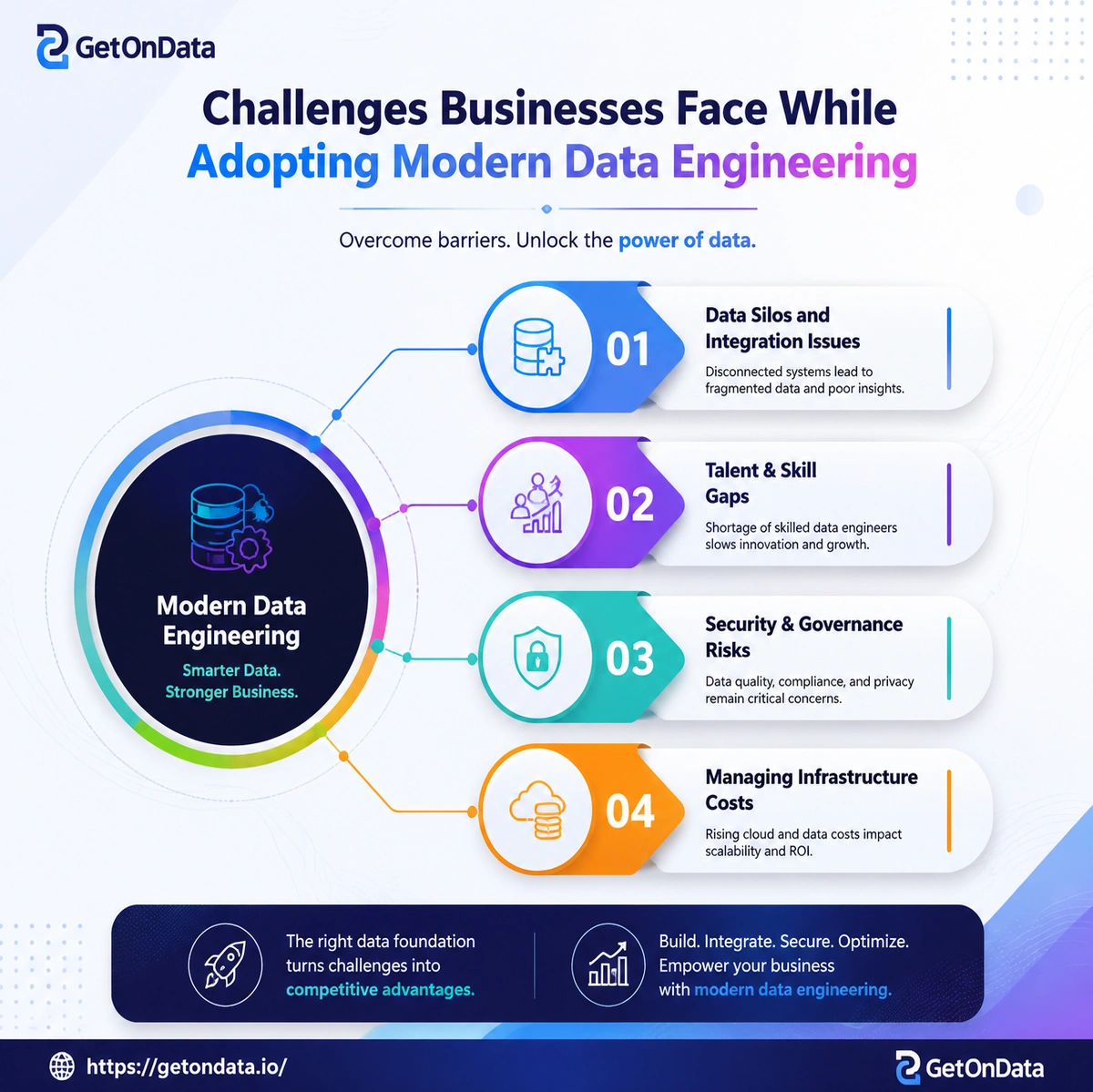
✦ Data Silos and Integration Issues
Organizations often struggle with disconnected data systems & integration challenges while adopting advanced data engineering practices. Legacy systems may not support advanced cloud platforms, leading to compatibility errors. Cross-platform synchronization becomes complicated when managing multiple apps, databases, and data sources. It results in inconsistent data, delayed reporting, and limited operational efficiency across departments.
✦ Talent & Skill Gaps
Advanced data engineering demands highly skilled professionals skilled in cloud platforms, automation, AI, and analytical systems. Most of the firms face a lack of a skilled team capable of managing modern data architectures. The rising demand for professionals in AI and data engineering makes recruitment tough and slows down the virtual transformation initiatives for firms.
✦ Security & Governance Risks
Data security and governance remain major concerns for organizations implementing modern data engineering solutions. Businesses must comply with evolving privacy regulations while safeguarding crucial user data. Weak governance frameworks, unauthorized access, and poor monitoring systems can increase the risk of data breaches, compliance violations, and loss of customer trust.
✦ Managing Infrastructure Costs
Infrastructure management expenses are a significant challenge as an organization scales advanced data engineering environments. Processing, cloud storage & streaming workload can smartly improve operational cost without optimization. Most of the firms depend on data engineering consulting solutions to uplift workload efficiency, optimize resources, and minimize cloud investment while managing scalable data operations.
Also Read: Power BI Consultant in USA for Scalable Business Intelligence Solutions
Best Practices for Building Future-Ready Data Engineering Systems
➔ Invest in Scalable Architecture
Firms must build scalable data engineering systems using cloud-native infrastructure and flexible compute environments. Advanced architectures must support rising data volumes, real-time processing, and multi-cloud operations. Scalable storage & processing system enhances performance, allowing firms to quickly adapt to changing firm and tech demands.
➔ Prioritize Data Quality
Managing data quality is crucial for accurate analytics and reliable firm decisions. The firm must implement a frequent validation process, a real-time tracking system, and automated quality inspection. Data observability tools support tracking inconsistencies, missed records, and anomalies. It ensures trustworthy data pipelines while enhancing the accuracy of analytics and reporting outcomes.
➔ Embrace Automation
Automation supports firms in streamlining data engineering operations and limiting manual work. AI-based pipeline management optimizes processing, monitors errors, and enhances operational efficiency automatically. Automated QA & deployment practices support quick release, reducing the chances of errors. It supports frequent integration, allowing firms to manage data systems efficiently.
➔ Build Strong Governance Policies
Strong governance policies support firms in managing data security, operational consistency, and compliance. Firms must implement RBA controls, encryption standards, and clear compliance frameworks to safeguard crucial data. Effective governance enhances accountability, supports compliance requirements, and verifies secure and responsible data usage across enterprise systems.
➔ Enable Cross-Team Collaboration
The future-ready data engineering system demands collaboration between technical & business teams. Shared data ownership encourages accountability & enhances data accessibility across departments. Self-service analytics platforms allow teams to access and measure data independently, limit reliance on the centralized team while enhancing decision speed, operational efficiency, and organizational collaboration.

Ready to Build an AI-Driven & Real-Time Data Ecosystem?
The data engineering trends 2026 mentioned above reflect an innovative journey to move towards a future where data is handled efficiently. Organizations that modernize their data infrastructure today lead to tomorrow’s AI-driven economy. If you want to invest in secure, scalable, and AI-ready engineering practices, hire data engineering services.
Top Data Engineering Company in USA: Key Services Explained
Data is no longer something that only highlights an operation. It has become the foundation of smarter and faster decision-making. As per the latest insights from IDC, in a few years, the global datasphere is going to reach 175 zettabytes. From startups to multi-national companies, everyone relies on accurate and real-time insights to stay competitive.
But generating reliable data pipelines and clean datasets needs more than tools. It desires expertise and proper execution. This is why choosing the right data engineering company influences how your data turns into proper value. Right from data integration to analytics, the right partner can help you discover performance while helping your business become digitally rich.
What is Data Engineering?
Let us learn more about data engineering and how it has been proving its relevance in the recent digital scenario.
➔ Definition of Data Engineering
Data engineering is the ultimate procedure of gathering, transforming, and handling data so it becomes consistent and usable. It includes building pipelines and structuring raw information into formats that your system can easily process. This discipline acts as the backbone of analytics and AI systems, ensuring data is able to offer meaningful insights.
➔ Role in Modern Businesses
In today’s data-rich environment, data engineering services can support your business intelligence by offering clean and well-structured data to decision-makers. It enables real-time insights, allowing you to respond quickly to meet the interests of market shifts and customer behavior. It also encourages operational efficiency by reducing manual efforts.
Why Choose a Data Engineering Company in the USA?
Here are the reasons that prove the benefits of seeking the help of professional data engineering companies in the USA.
⊛ Access to Advanced Technologies
Leading companies have access to modern cloud platforms like Azure, AWS, and GCP to build flexible and high-performing data ecosystems. This ensures faster processing.
⊛ Skilled Talent Pool
You can enjoy your access to experienced data engineers and architects who understand the complicated data challenges across industries. Their expertise can help you design efficient pipelines.
⊛ High-Quality Standards
US based companies value strict global data regulations and data integrity. They also deliver efficient solutions that can change as per your business growth and strategic requirements.
Key Services Offered by Top Data Engineering Companies
Here are the top data engineering services that most of the leading companies offer to their clients.
➤ Data Pipeline Development
Top data engineering services include creating scalable pipelines that effectively move and process data across systems. They support real-time and batch processing to ensure timely data flow.
➤ Data Warehousing Solutions
Companies design effective data warehouses with ETL implementation to change and organize data efficiently. This enables structured storage that values fast querying.
➤ Big Data Analytics Services
These data engineering services manage large-scale data processing to discover valuable insights from complicated datasets. They also offer detailed reporting while helping you make competitive decisions.
➤ Cloud Data Engineering
Experts can assist you with seamless cloud migration while setting up precise data lakes. This ensures flexibility and easy access to growing data volumes.
➤ Data Integration Services
Experts enable effective integration of data from multiple sources. This eliminates errors and inconsistencies. Your business can also get continuous data flow through proper API connectivity.
➤ Data Governance & Security
Companies can easily implement data quality management practices to maintain accuracy and consistency. They also ensure compliance to protect your business data.
Top Data Engineering Company in the USA
Here is the complete list of top data engineering services companies in the USA for your reference.
1. GetOnData.io
This is a data-rich consulting company, prompt in data engineering, along with AI-driven assessment. Being the best data engineering company in the USA, it can assist your business in transforming raw data into actionable outcomes and advanced analytics.
| Sr. No. | Key Points | Services Provided |
|---|---|---|
| 1 | Founded Year: 2019 | Data Analytics |
| 2 | Employees: 11-50 | Data Engineering |
| 3 | Location: USA | Microsoft Fabric |
| 4 | LinkedIn: View Profile | Azure Data Bricks |
| 5 | Website: GetOnData | Power BI |
2. Agile Infoways
It is a global IT and data solutions provider offering data engineering and business intelligence services. This can help you build unified and scalable infrastructures. With 18+ years of expertise, it supports every type of business with complete digital changes.
| Sr. No. | Key Points | Services Provided |
|---|---|---|
| 1 | Founded Year: 2006 | Data Engineering |
| 2 | Employees: 201 – 500 | Data Design |
| 3 | Location: USA | Data Visualization |
| 4 | LinkedIn: View Profile | Predictive Analytics |
3. United Techno
United Techno is considered for offering data engineering and software solutions that can help your business align data processing and improve decision-making. The company prioritizes integrating modern technologies for vast enterprise growth.
| Sr. No. | Key Points | Services Provided |
|---|---|---|
| 1 | Founded Year: 2011 | Data Engineering |
| 2 | Employees: 201 – 500 | Data Integration |
| 3 | Location: USA | Data Strategy |
| 4 | LinkedIn: View Profile | Data Analytics |
4. TechEnhance
This company offers some of the most essential data engineering services in the USA. It can help your organization modernize its data infrastructure and discover better insights for valuable business optimization.
| Sr. No. | Key Points | Services Provided |
|---|---|---|
| 1 | Founded Year: 2023 | Data Engineering |
| 2 | Employees: 11 – 50 | Data Strategy & Consulting |
| 3 | Location: USA | Data Visualization |
| 4 | LinkedIn: View Profile | Advanced Analytics |
5. Xduce
This is a data-driven technology company offering services in data engineering and enterprise solutions. It specializes in assisting organizations in handling complicated data environments and gathering value through advanced data strategies.
| Sr. No. | Key Points | Services Provided |
|---|---|---|
| 1 | Founded Year: 2006 | Data Engineering |
| 2 | Employees: 501 – 1000 | Data Analytics |
| 3 | Location: USA | Data Migration |
| 4 | LinkedIn: View Profile | Advanced Analytics |
6. RSM US
RSM US is a top consulting partner that offers analytics and business intelligence solutions along with data engineering. It can support mid-level companies with secure and effective data platforms to drive informed decision-making.
| Sr. No. | Key Points | Services Provided |
|---|---|---|
| 1 | Founded Year: 1926 | Data Engineering |
| 2 | Employees: 10,000+ | Data Migration |
| 3 | Location: USA | Data Quality & Governance |
| 4 | LinkedIn: View Profile | Analytics Process Automation |
7. HSO
HSO offers end-to-end data engineering capabilities designed to align your data operations. It also prepares organizations for advanced analytics and AI-rich transformation that works incredibly in the competitive edge.
| Sr. No. | Key Points | Services Provided |
|---|---|---|
| 1 | Founded Year: 1987 | Data Engineering |
| 2 | Employees: 1,001 – 5,000 | Data Integration |
| 3 | Location: USA | Data Strategy |
| 4 | LinkedIn: View Profile | Business Intelligence |
8. Concord USA
This company can help your team with modern data architecture consulting and data model development. This leading company has also highlighted its expertise in data implementation and big data engineering. It has already given rise to many data-centric ecosystems.
| Sr. No. | Key Points | Services Provided |
|---|---|---|
| 1 | Founded Year: 2003 | Data Engineering |
| 2 | Employees: 1,001 – 5000 | Data Analytics |
| 3 | Location: USA | Data Management |
| 4 | LinkedIn: View Profile | Data Visualization |
9. Contata
The experts in this company specialize in data engineering and cloud solutions, along with precise analytics. This can help you discover complicated datasets with ease. It also focuses on offering scalable data platforms and improving data accessibility.
| Sr. No. | Key Points | Services Provided |
|---|---|---|
| 1 | Founded Year: 2000 | Data Analytics |
| 2 | Employees: 501 – 1,000 | Data Visualization |
| 3 | Location: USA | Data Mining |
| 4 | LinkedIn: View Profile | Customer Analytics |
10. Aimpoint Digital
This company is a data and analytics consulting company that can assist your business in leveraging modern data engineering practices. It focuses on creating data pipelines and AI-rich solutions that can help your business outcomes evolve.
| Sr. No. | Key Points | Services Provided |
|---|---|---|
| 1 | Founded Year: 2017 | Data Engineering |
| 2 | Employees: 201 – 500 | Data Architecture |
| 3 | Location: USA | Data Strategy |
| 4 | LinkedIn: View Profile | Analytics Strategy |
How to Choose the Best Data Engineering Company in USA
➥ Evaluate Experience & Portfolio
A review of experience should not be limited to simple year-counting. Prioritize case studies indicating results, approaches, and problems. Expertise in a particular field is of great importance, for the context of data problems can vary greatly. A firm with the relevant field expertise knows how to effectively design approaches to solve data problems with adequate consideration to domain regulatory and operational, as well as performance data constraints.
➥ Technology Stack Expertise
A good data engineering consultant is well-versed in the current ecosystems that include distributed computing, cloud-native, and data orchestration systems. The emphasis should also be placed on the way these tools are applied, rather than focusing only on the tools themselves. Solutions of the future will require advancements, systems, and structures designed to be adaptable, scalable, and able to meet evolving data needs within the business.
➥ Client Reviews & Testimonials
Authentic client feedback demonstrates how a company executes its work under real project conditions. The reviews show patterns that demonstrate the company’s capacity to deliver consistent results through effective communication and trustworthy operational practices. The establishment of lasting partnerships demonstrates that clients trust the company because they continue to deliver value while adjusting to market changes and business needs.
➥ Cost vs Value
The selection of a partner needs more evaluation than their price because their expenses impact both operational efficiency and business expansion. The total value assessment needs to include system performance and maintainability as its measurement criteria. Professional organizations use clear pricing models to establish their credibility, while businesses achieve growth and operational efficiency through investments that deliver returns and enable better data management.
Benefits of Hiring a Data Engineering Company
◈ Faster data processing
Through the creation of effective countermeasures, the dedicated team facilitates the collection of large data sets with minimal latency during the various stages of data collection. With efficient workflows available alongside data engineering consulting solutions, clients unblock business potential and attain the capability of real-time data processing.
◈ Better decision-making
Insights that channel through reliable data systems are accurate and timely. When the data systems are reconciled and the data is of high quality, the clients are able to make timely market decisions with a high level of confidence and a lower level of uncertainty.
◈ Scalable infrastructure
Data engineering provides organizations with flexible architectural designs that adapt to their developing business requirements. The organization maintains operational capacity through its scalable infrastructure, which handles increasing data volumes and supports new system connections and advanced analytical processes without experiencing performance degradation.
◈ Improved data accuracy
Data accuracy improved through enhanced data verification processes and data transformation methods, which prevented data matching errors and duplicate records from entering the system. The enhancement process established strong data verification and transformation methods, which created data integrity for better analytics results and increased trust among operational teams who depended on data resources.
Industries That Benefit from Data Engineering Services
⦾ Healthcare
A data engineering company is necessary for healthcare organizations to store, analyze, and integrate patient records, clinical data, and real-time data. Structured data in the company’s systems sets ways to streamline functionalities and deal with the complex systems in healthcare.
⦾ Finance
Financial institutions use data engineering to process large transaction volumes while their systems detect fraud and their teams handle risk management. The organization achieves rapid reporting and regulatory compliance together with precise forecasting through its reliable pipelines and secure systems, which operate in a highly data-sensitive environment.
⦾ E-commerce
Data engineering is critical for e-commerce companies to monitor and analyze customer behavior, maintain inventory, and adjust prices accordingly. Systems built on clear and well-structured data help to personalize e-commerce operations, increase sales conversion, and provide data for real-time assessment of sales and demand.
⦾ Manufacturing
Data engineering is used by manufacturers to track their production lines, predict when equipment will fail, and streamline their supply chain. Systems built on integrated, clear, and well-structured data help manufacturers improve their operations and logistics, reduce loss of production, and promote data-driven decisions.
⦾ SaaS
SaaS companies use data engineering for analyzing user behavior, monitoring platform performance, and achieving efficient infrastructure scaling. Product development, customer retention programs, and analytic tool integration with third-party services all depend on strong data foundations.

Ready to Transform Your Data Strategy?
Collaborate with specialized professionals who examine your existing data environment and address your organization’s business priorities by offering recommendations and solutions for gaps you wish to fill.
Leverage advanced analytics. The tableau analytics consulting services will enhance reporting capabilities through interactive dashboard development and improved data visualization techniques, which help users understand intricate business data patterns.
Data and analytics solutions developed to enhance business function and aid companies to achieve their business goals through guided strategies and efficiency improvements are developed to empower teams to make confident and reliable data-supported decisions.