
Data engineering has become an essential aspect of modern life. Data engineers design, construct, and oversee infrastructures to collect, store, and process large volumes of information efficiently—ensuring data reliability, accessibility, and informed decision-making across various industries.
Selecting appropriate tools is of utmost importance in data engineering. Appropriate data pipeline tools must be capable of managing large volumes of data efficiently while offering scalability and integrating seamlessly with existing systems. Using advanced data engineering solutions can leverage robust infrastructures and optimized pipelines to ensure seamless data processing and workflow efficiency.
Data engineering technologies have experienced remarkable advancement over time. Their rapid progress reflects an innovative spirit to enhance data processing capacities and meet emerging industry challenges.
Recent results of Forbes conducted with 90 companies showed that data integration technologies is essential to their success.
Understanding Data Engineering
Data engineering is the practice of designing, constructing, and managing data pipelines, which facilitate the flow of data from various sources to analytical and operational systems. The goal is to make data available, reliable, and structured in a way that supports business intelligence, machine learning, and other analytical applications.
Ensuring data quality with data engineering is an approach for managing large volumes of information efficiently while making it accessible and usable. It involves various stages such as ingestion, processing, and storage orchestration transformation using tools designed specifically to deal with such volumes of information.
A well-structured pipeline improves performance while decreasing mistakes and optimizing decisions, so understanding its components will assist with designing resilient yet scalable data architectures.
What Matters Most in Data Engineering: Essential Components
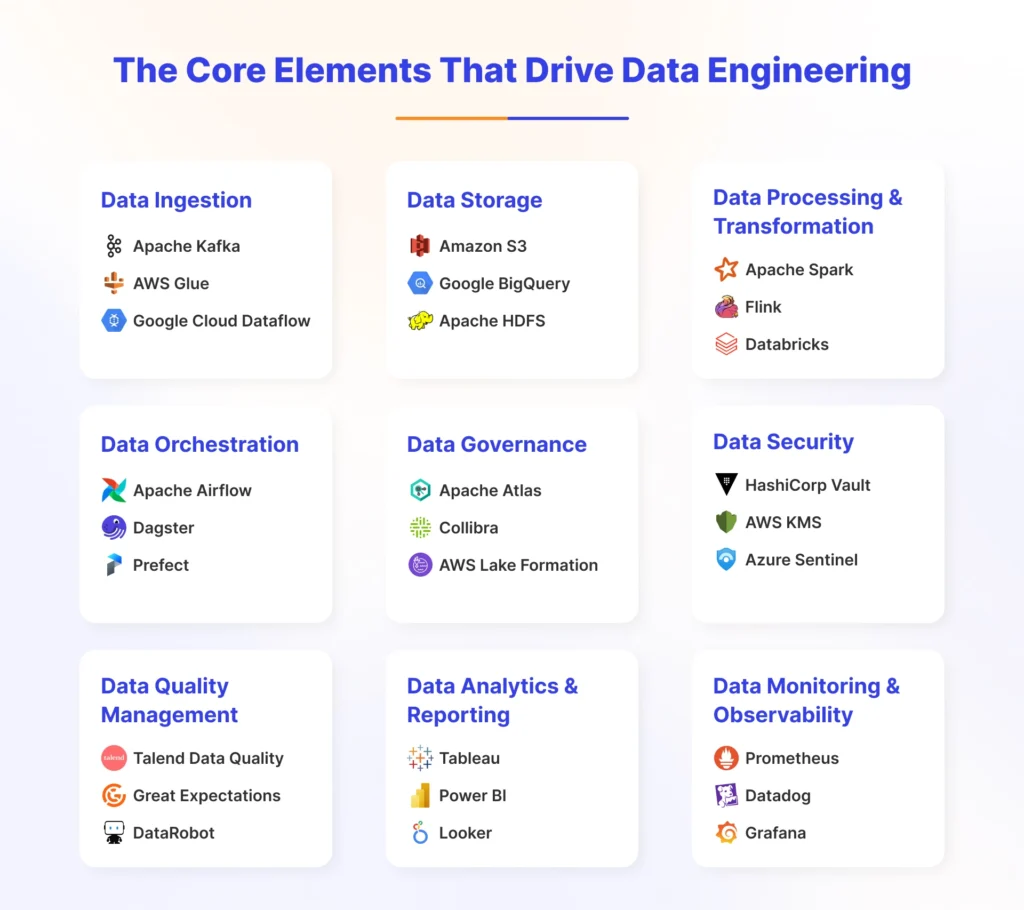
Data Ingestion
What they are:
Data ingestion is the process of collecting raw data from various sources, such as databases, APIs, IoT devices, and logs. It ensures that structured, semi-structured, and unstructured data are gathered efficiently. This is the first step in building a data pipeline.
What they do:
It brings data from multiple sources into a centralized storage system for processing and analysis. The process can be real-time (streaming) or batch-based, depending on business needs. Data ingestion ensures data availability for downstream tasks like transformation and analytics.
How they are connected to data engineering:
Data ingestion forms the foundation of data pipelines, enabling further processing and analytics. Without an effective ingestion strategy, data quality and timeliness can be compromised. It ensures a seamless flow of data from sources to storage and processing units.
Tools used:
- Apache Kafka – A distributed event streaming platform for real-time data ingestion.
- Apache Nifi – Automates data flow between systems in a scalable way.
- AWS Glue – A managed ETL service that supports data ingestion from multiple sources.
- Google Cloud Dataflow – A real-time data processing and ingestion service.
Example:
A retail company collects transactional data from online purchases, point-of-sale (POS) systems, and mobile apps. Using Apache Kafka, it streams the sales data into a data warehouse in near real-time. This allows for real-time inventory tracking and personalized recommendations.
Data Storage
What they are:
Data storage refers to the systems and technologies used to store large volumes of structured and unstructured data. It includes databases, data lakes, and warehouses that stores raw and processed data. Storage solutions must be scalable, secure, and optimized for performance.
What they do:
It provides a foundation for data accessibility and retrieval for further processing. Storage solutions ensure data is organized, indexed, and available for querying. Depending on use cases, data can be stored in relational databases, NoSQL databases, or distributed storage systems.
How they are connected to data engineering:
Data engineering relies on efficient storage to support large-scale data operations. The choice of storage affects data accessibility, performance, and analytics capabilities. Proper storage ensures seamless data retrieval and processing in downstream applications.
Tools used:
- Amazon S3 – A scalable object storage service for structured and unstructured data.
- Google BigQuery – A serverless data warehouse for analytics and reporting.
- Apache HDFS – A distributed file system used in big data processing.
- PostgreSQL – A relational database for structured data storage.
Example:
A healthcare company stores patient records in a PostgreSQL database for structured data and uses Amazon S3 to store scanned medical reports. This enables quick access to patient history and supports machine learning models for diagnostics.
Data Processing & Transformation
What it is:
Data processing and data transformation together is a comprehensive phase that refers to the action of cleansing, aggregating, and enriching raw data into a clean, usable and meaningful structure. In broad terms, the data processing pipeline entails many steps, and data transformation is one of them. It involves filtering, data normalization, and changes in the schema so that the data becomes ready for analysis.
What it does:
Data processing improves the quality and integrity of processed data by applying business rules, deduplication, and filtering, hence preparing it for downstream tasks. While data transformation is part of standardization and refinement in the data processing pipeline that removes inconsistencies, the data can be used for reporting, analytics, and machine learning tasks.
How it connects to Data Engineering:
While Data transformation is a crucial step in ETL (Extract, Transform, Load) pipelines, ensuring that raw data is converted into a format suitable for storage and analysis removing inconsistencies, so the data can be used for reporting, analytics, and machine learning tasks. Data processing improves the quality and integrity of processed data by applying business rules, deduplication, and filtering, hence preparing it for downstream tasks. Proper data processing leads to accurate and actionable insights.
Key Tools:
- Data Processing: Apache Spark, Flink, Databricks, AWS Lambda, etc.
- Data Transformation: dbt, Apache Beam, Talend, AWS Glue, Airflow, Google Dataflow, etc.
Example:
As an example, a retail company would process sales data, and as a part of the transformation step, aggregate revenue per store and convert different currencies into one for proper financial reporting.
Data Orchestration
What it is:
Data orchestration automates and manages the execution of different data processes in a pipeline. It ensures that tasks like ingestion, transformation, and storage happen in the correct order. This component is critical for workflow scheduling and monitoring.
What it does:
It coordinates the flow of data across multiple sources, processing engines, and storage systems. Orchestration ensures dependencies are met, prevents failures, and retries tasks if errors occur. It improves efficiency and reliability in data pipelines.
How it connects to data engineering:
Without data orchestration, managing complex data workflows would be chaotic. It provides visibility into data processes, ensuring smooth execution of ETL jobs, real-time processing, and cloud-based workflows. It helps maintain consistency in large-scale data systems.
Tools Used:
- Apache Airflow – A workflow management tool for orchestrating data pipelines.
- Prefect – A modern data workflow orchestration tool.
- Luigi – A Python-based workflow orchestration system.
- Dagster – A data orchestration platform with built-in testing and monitoring.
Example:
A media company schedules daily data pipelines in Apache Airflow to process video engagement analytics, ensuring timely insights for content recommendations.
Data Governance
What it is:
Data governance involves defining policies, standards, and practices to ensure data security, privacy, and compliance. It establishes rules on how data is accessed, shared, and maintained. Governance is critical for regulatory compliance and risk management.
What it does:
It enforces data access controls, ensuring only authorized users can view or modify data. Governance ensures that data is high-quality, well-documented, and compliant with laws like GDPR and HIPAA. It prevents data breaches and misuse.
How it connects to data engineering:
Without governance, organizations risk data leaks, non-compliance penalties, and inaccurate analytics. Data engineering teams rely on governance frameworks to ensure that pipelines maintain privacy standards, auditing capabilities, and data lineage tracking.
Tools Used:
- Apache Atlas – A metadata management and data governance tool.
- Collibra – A data governance and cataloging platform.
- Alation – A tool for data discovery, governance, and collaboration.
- AWS Lake Formation – A service to manage and secure data lakes.
Example:
A healthcare provider implements strict data governance policies to ensure patient medical records are accessed only by authorized doctors and comply with HIPAA regulations.
Data Security
What it is:
Data security involves protecting sensitive information from unauthorized access, breaches, and corruption. It includes encryption, access controls, and monitoring systems. Security is a top priority in data engineering, ensuring trust and compliance.
What it does:
It prevents cyber threats, insider attacks, and accidental data leaks by implementing authentication and encryption mechanisms. Security tools monitor data access patterns to detect anomalies and prevent unauthorized modifications. Strong security ensures business continuity.
How it connects to data engineering:
Data engineers integrate security measures into every stage of the data pipeline. They ensure data at rest and in transit is encrypted, access is restricted, and compliance policies are met. Without proper security, businesses risk financial and reputational damage.
Tools Used:
- HashiCorp Vault – A tool for managing secrets and encrypting data.
- AWS KMS – A managed encryption key service.
- Azure Sentinel – A cloud-native security information and event management (SIEM) tool.
- Splunk – A security and event management tool for data monitoring.
Example:
A financial services company encrypts customer credit card data before storing it in a database, ensuring that even if a breach occurs, the data remains protected and unreadable.
Data Quality Management
What it is:
Data quality management ensures that data is accurate, complete, and consistent. It involves data validation, deduplication, and standardization. High-quality data leads to better business decisions and insights.
What it does:
It removes inconsistencies, corrects errors, and standardizes values across datasets. It includes techniques like anomaly detection, missing value handling, and duplicate removal. Quality management ensures that analytics and machine learning models produce reliable results.
How it connects to data engineering:
Poor data quality leads to incorrect analytics, business inefficiencies, and compliance risks. Data engineers implement quality checks at each stage of the pipeline to maintain data integrity. High-quality data enhances operational efficiency and decision-making.
Tools Used:
- Great Expectations – A tool for data validation and testing.
- Talend Data Quality – A data cleansing and validation platform.
- Apache Griffin – A data quality assessment framework.
- DataRobot – A tool for automated data quality monitoring.
Example:
A telecom company detects duplicate customer records using a data quality framework, preventing incorrect billing and improving customer satisfaction.
Data Analytics & Reporting
What it is:
Data analytics involves analyzing structured and unstructured data to extract insights. Reporting tools visualize these insights to help businesses make informed decisions. It is the final stage in the data pipeline.
What it does:
It applies statistical and machine learning techniques to identify trends and patterns. Reporting dashboards display key metrics for executives and stakeholders. Analytics helps in forecasting, anomaly detection, and strategic decision-making.
How it connects to data engineering:
Data engineers build pipelines that feed clean, structured data into analytics platforms. Without proper engineering, analytics tools cannot function efficiently. Scalable data architecture ensures timely insights.
Tools Used:
- Tableau – A data visualization and business intelligence tool.
- Power BI – A Microsoft tool for interactive analytics.
- Looker – A cloud-based BI platform.
- Google Data Studio – A free data visualization tool.
Example:
A marketing team uses Power BI to track customer engagement metrics, helping them optimize ad campaigns based on real-time insights.
Data Monitoring & Observability
What it is:
Data monitoring ensures data pipelines run smoothly by tracking performance, errors, and data anomalies. Observability extends monitoring by providing deeper insights into system health and dependencies.
What it does:
It detects failed jobs, slow queries, and unusual data patterns, allowing teams to take corrective actions. Observability tools provide dashboards and alerts for proactive management. Continuous monitoring ensures high data pipeline reliability.
How it connects to data engineering:
Without monitoring, data pipelines may fail without detection, leading to lost revenue and poor decision-making. Engineers use observability tools to maintain uptime, optimize performance, and troubleshoot errors.
Tools Used:
- Prometheus – An open-source monitoring tool for metrics collection.
- Grafana – A visualization tool for real-time monitoring dashboards.
- Datadog – A cloud-based monitoring platform.
- Monte Carlo – A data observability platform for detecting pipeline issues.
Example:
A logistics company uses Grafana dashboards to monitor real-time shipment tracking data, ensuring delivery updates remain accurate and timely.
Understanding these key components allows organizations to build efficient data architectures for insight and decision-making purposes.
Future Trends in Data Engineering
The field of data engineering is evolving rapidly, driven by advancements in automation, cloud computing, and AI-driven analytics. Automation and AI-powered data pipelines are reducing manual efforts, enabling intelligent data integration, transformation, and anomaly detection.
Real-time data processing is becoming a necessity, with organizations adopting stream processing frameworks like Apache Flink and Kafka Streams for instant insights. The rise of DataOps and MLOps is improving collaboration between data engineers and data scientists, ensuring smoother deployment of machine learning models. Serverless and cloud-native architectures are optimizing cost and scalability, allowing businesses to process vast amounts of data efficiently.
Additionally, data governance and observability are gaining importance to maintain data quality, security, and compliance in an increasingly regulated digital landscape. As businesses continue to prioritize data-driven decision-making, data engineering will play a crucial role in shaping the future of AI, analytics, and business intelligence.
Tips to select appropriate Data Engineering Tools
- Recognize Your Business Needs: In order to select tools that fulfil the desired outcomes of your organization’s data storage, processing, and analytics initiatives, identify all data storage, processing, and analytics requirements that exist within it.
- Scalability and Performance: Make sure that the tool can easily accommodate expanding data volumes without impeding its performance.
- Integration Capabilities: Analyse compatibility for existing databases, cloud services and third-party apps.
- Ease of Use and Learning Curve: When selecting tools, make sure they suit the experience and training needs of your team while requiring minimal instruction or direction from administrators.
- Cost and Licensing: To effectively oversee costs and licensing requirements, evaluate different pricing models, such as open source versus commercial, in addition to the total cost of ownership, including maintenance.
- Security & Compliance – To comply with data governance, encryption, and regulatory requirements. Utilise appropriate tools for real-time stream processing or batch processing needs.
- Extensibility: Look for tools with customization features, such as scripting or API integration, that ensure future scalability.
- Documentation and Community Support: When looking for tools with active user communities and regular updates, as well as active forums.
- Consider vendor support & SLAs: When exploring paid options, ensure to assess vendor support, uptime guarantees and service level agreements (SLAs).
Struggling to Choose the Right Tools for your Business?
The Essential Role of Data Engineering Tools in Modern Enterprises
Data engineering tools and technologies form the backbone of efficient data management, enabling businesses to collect, process, store, and analyze data at scale. From ingestion to governance, each tool plays a vital role in ensuring data is reliable, secure, and actionable.
As organizations continue to adopt data-driven strategies, the right set of tools can significantly enhance operational efficiency and decision-making.
Which tools should you choose for your data engineering needs?
The choice of tools depends on factors such as data volume, processing requirements, and business objectives. Whether it’s Apache Spark for large-scale processing, Airflow for workflow orchestration, or Snowflake for cloud storage, selecting the right technology stack ensures a seamless and scalable data infrastructure.

