Organizations generate vast amounts of complex, fast-moving data from multiple sources. This makes it difficult for traditional data platforms to keep current. Legacy systems often struggle with scalability, slow processing, siloed workflows, and limited organizations’ ability to extract real-time insights. As organizations widely adopt cloud data platforms, real-time analytics, and AI, the popularity of agile and powerful solutions continues to grow. This is where Azure Databricks services come to offer a unified platform that combines data engineering, analytics, and AI.
The 2026 State of AI agent report reveals more than 20 thousand organizations globally use Databricks and AI platforms including 60% companies listed in Fortune 500. Azure Databricks helps enterprises to build scalable, efficient, and future-ready data solutions that support future digital transformation goals.
What Is Azure Databricks?
⟹ Understanding Azure Databricks Platform
Azure Databricks is the cloud-based data and AI platform designed on Apache Spark for high-performance data processing. It combines data analytics, data engineering, and ML into a single integrated environment. This collaborative platform allows data teams to work together seamlessly, sharing code, insights, and workflows. It ultimately improves development cycles and productivity across data-driven enterprise projects.
⟹ How Azure Databricks Works?
Azure Databricks integrates easily with various enterprise data sources, allowing smooth data ingestion from multiple systems. It processes and transforms large volumes of structured and unstructured data efficiently. Using advanced lakehouse architecture, it can store and manage data with consistency and reliability. The foundation allows advanced analytics and streamlines ML model development at scale.

Why Enterprises Need Azure Databricks for Modern Data Solutions
➥ Managing Growing Enterprise Data Challenges
Organizations face a huge volume of data generated from applications, IoT devices, and core business systems. This increase makes it tough to manage data quality, consistency, and accessibility across teams. In addition, organizations need quick insights to support real-time decision-making. Azure Databricks addresses these challenges by offering a scalable and unified platform for efficient data management.
➥ Overcoming Limitations of Traditional Data Platforms
Traditional data platforms depend on disconnected tools, creating inefficiencies and data silos. Azure Databricks reduces dependencies by combining data engineering and AI in one environment. It delivers superior scalability compared to legacy systems for managing growing workloads. It simplifies complex data processing workflows and allows businesses to operate efficiently.
➥ Supporting Data-Driven Business Transformation
Azure Databricks empowers businesses to adopt modern AI and analytics and drive smarter business decisions. It allows firms to build scalable data environments. By allowing faster access to reliable data insights, the platform supports frequent innovations, helping businesses transform digitally and stay competitive in an evolving market.
Also Read: End-to-End Microsoft Fabric Consulting Services for Scalable Data Management
Key Benefits of Azure Databricks for Enterprises
⟹ Faster Data Processing and Analytics
Apache Spark enables high-speed data processing and analytics, helping enterprises process vast datasets quickly and reduce time-to-insights. With Azure Databricks solutions, teams can make faster, data-driven decisions, respond promptly to market changes, and improve operational efficiency across various business functions and workloads.
⟹ Unified Platform for Data Teams
Azure Databricks brings analysts, data engineering experts, and scientists together in a single platform. Teams can share code and insights seamlessly and eliminate silos between departments. The unified environment simplifies communication, improves project delivery, and innovation by allowing diverse data professionals to work together for a common goal.
⟹ Scalable Cloud Data Infrastructure
Azure Databricks, designed for the cloud, offers highly scalable infrastructure that grows with enterprise requirements. Businesses can seamlessly scale compute resources up or down based on workload demands. This flexibility offers consistent performance during peak usage while optimizing costs. These azure databricks features make it an ideal option for businesses managing evolving data volumes.
⟹ Accelerates AI and Machine Learning Adoption
Azure Databricks simplifies the ML lifecycle from data preparation to model deployment. It has built-in tools and integrations with Azure AI services, supporting teams to build, train, and deploy models quickly. The adoption of ML and AI helps enterprises to embed advanced capabilities into products and processes, and improves innovation.
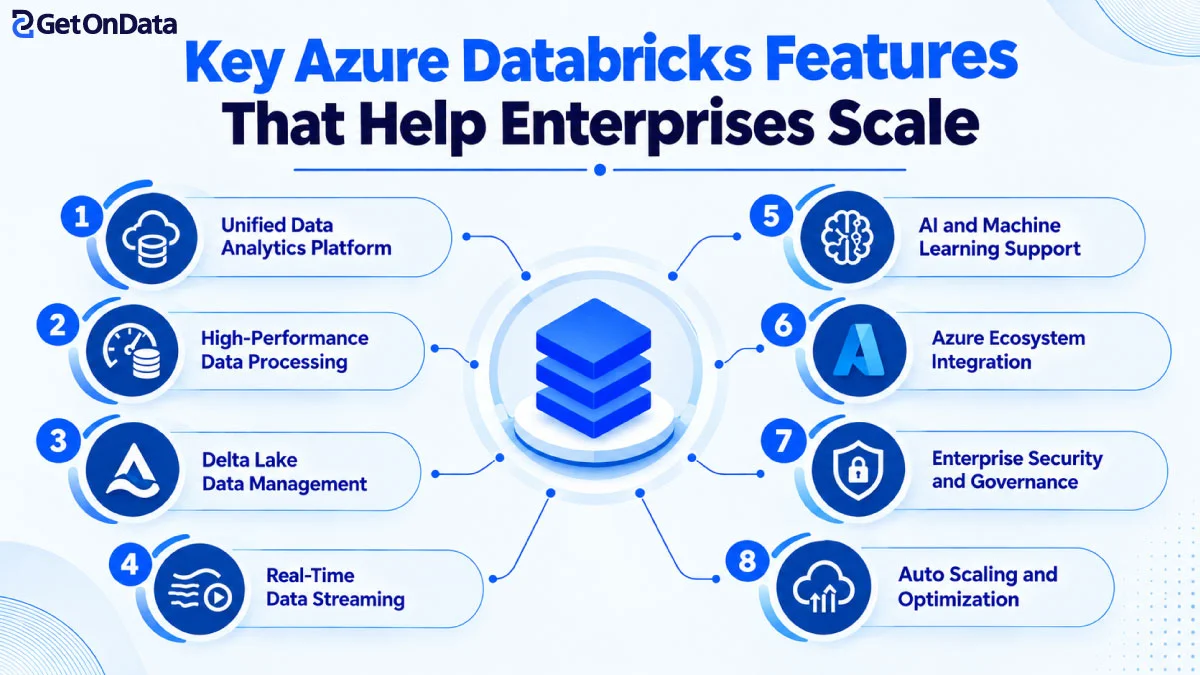
Key Azure Databricks Features That Help Enterprises Scale
➥ Unified Data Analytics Platform
Azure Databricks removes the need for separate tools by combining data engineering, analytics, and AI into a single collaborative platform. Teams can improve cross-functional cooperation by creating, testing, and managing data workflows in a single environment. This cohesive strategy helps businesses manage data pipelines more effectively at scale, reduces project timeframes, and lowers operational complexity.
➥ High-Performance Data Processing
Azure Databricks, which is based on Apache Spark, offers robust distributed computing for processing massive amounts of data. It helps businesses to process large datasets effectively by handling real-time tasks quickly and reliably. Organizations may swiftly extract insights without hampering scalability or processing accuracy because of its high-performance engine’s support for intricate transformations and analytics.
➥ Delta Lake Data Management
By incorporating ACID transactions and consistency into data lakes, Delta Lake improves data reliability. It lowers errors in data pipelines by supporting rollback capabilities, data versioning, and schema enforcement. Cleaner, more reliable data, easier audits, and better governance let businesses manage massive amounts of both organized and unstructured data with confidence.
➥ Real-Time Data Streaming
Azure Databricks allows frequent processing of streaming data from various sources. Businesses can monitor processes, identify inefficiencies, and produce insights with its real-time capability. Organizations can make decisions more quickly with faster access to real-time data. It gives them a competitive advantage in fast-paced, dynamic business contexts.
➥ AI and Machine Learning Support
The Azure Databricks features and benefits offer powerful capabilities for large-scale ML model development, training, and deployment. Teams can speed up the lifecycle, from testing to production, with native integration. Businesses can build intelligent, data-driven capabilities into their operations and apps, which speeds up innovation.
➥ Azure Ecosystem Integration
Azure Databricks creates a unified cloud data environment by integrating with services like Power BI, and Azure Data Lake Storage. This interface supports end-to-end analytics operations, improves reporting, and makes data migration easier. Businesses can benefit from a unified architecture where data moves seamlessly between tools. It increases productivity and lowers integration cost.
➥ Enterprise Security and Governance
Azure Databricks contains built-in security features, such as encryption, and RBAC control. The Azure Databricks features and use cases protect sensitive data and guide organizations to follow the strict regulations. Businesses can be confident that their data is safe, compliant, and appropriately managed at every level.
➥ Auto Scaling and Optimization
Azure Databricks provides improved performance without human judgment. It dynamically scales resources based on workload demands. This dynamic resource management increases efficiency and manages costs. Auto-scaling maximizes resource utilization and maintains performance under high demands.
How Azure Databricks Helps Enterprises Build Scalable Data Solutions?
⟹ Building Modern Data Engineering Pipelines
Databricks on azure feature allows enterprises to design robust automated data engineering pipelines that efficiently manage data ingestion, transformation, and integration. Its architecture supports vast workloads and allows reliable data flow across systems. This advanced approach reduces manual efforts, and errors to build a strong foundation for scalable enterprise data operations.
⟹ Enabling Advanced Business Intelligence
With seamless integration into tools such as PowerBI, Azure Databricks allows enterprises to transform unstructured data into actionable metrics. Teams can design interactive dashboards and reports that offer brief insights into trends and performance. The improved visibility supports smarter, faster decision-making across departments. It drives measurable improvements in business outcomes.
⟹ Supporting Enterprise AI and Machine Learning
Azure Databricks offers the infrastructure and tools required to train, build, and deploy ML models at enterprise scale. Collaborating with a skilled Databricks consultant can further optimize the process and verify best practices in model development and deployment. The collaborative approach improves AI adoption support firms to achieve predictive insights and advanced automation.
⟹ Modernizing Legacy Data Infrastructure
Azure Databricks supports enterprises’ transition away from outdated legacy systems towards a flexible, cloud-native data architecture. It streamlines migration by supporting diverse data formats and sources. It reduces challenges during modernization, improves scalability, performance, and agility. It allows organizations to match rising data demands while securing overall data infrastructure strategy.
Real-World Enterprise Use Cases of Azure Databricks
➥ Retail and Customer Analytics
Retailers use Azure Databricks to measure user behavior across multiple touchpoints and achieve deeper insights into preferences and buying patterns. The data-driven practices improve personalization, deliver tailored recommendations, and enhance the experience. By leveraging advanced analytics, firms can optimize marketing strategies, target the right audience, and increase user engagement and sales.
➥ Financial Services and Risk Analytics
Financial firms also integrate Azure Databricks to monitor fraud patterns by measuring data transactions in real time. The azure databricks capabilities improves risk assessment through advanced analytics and ML models. It supports financial firms in detecting potential threats, achieving financial metrics, improving decision-making, strengthening compliance, and managing robust security across financial operations.
➥ Healthcare Data Analytics
Healthcare firms use Azure Databricks to run complex, high-volume medical information from multiple sources, including EHR and clinical systems. It supports predictive healthcare solutions and allows early detection of health risks. By improving data accessibility and analysis, the platform improves research capabilities and offers better patient outcomes across various treatments and medical care programs.
➥ Manufacturing and IoT Analytics
Manufacturers depend on azure databricks features capabilities to track equipment performance through real-time IoT data analysis. This visibility allows predictive maintenance, helps identify potential errors before they occur, and reduces costly downtime. By measuring production data frequently, firms can improve production efficiency, improve operations, overall manufacturing quality, and workflows.
Also Read: List of Data Engineering Services US Businesses Need in 2026
Best Practices for Implementing Azure Databricks
➛ Define clear data architecture goals– Set early goals to align Databricks implementation with business needs and long-term goals.
➛ Choose the right data processing strategy– Select appropriate batch, streaming, or hybrid approaches based on workload requirements.
➛ Optimize workloads and cluster performance– Configure the clusters efficiently and workloads for maximum speed and performance.
➛ Implement security and governance policies– Establish robust access controls, encryption, and compliance measures to safeguard enterprise data.
➛ Monitor usage and control cloud costs– Monitor resource consumption to avoid overspending and manage budget efficiency.
➛ Continuously improve data workflows– Frequently review and redefine pipelines to improve efficiency and adapt to needs.

Ready to Turn Your Data Into a Scalable Enterprise Solution?
Azure Databricks allows enterprises to manage complicated data challenges while supporting scalable analytics, modern data engineering, and AI. Businesses adopting this platform can improve decision-making, operational efficiency, and innovation. It helps to build a future-ready data foundation to meet rising demands. With expert Azure Databricks consulting, firms can use their data fully, obtain quick insights, and effective solutions for long-term success.

 Manufacturing Data Analytics